After all, “research” can be just walking around in the world with your eyes open. Collecting snippets of the world—or interviews, photos, art—and putting them together in ways that mean.
— Arianne Zwartjes, Autotheory as Rebellion
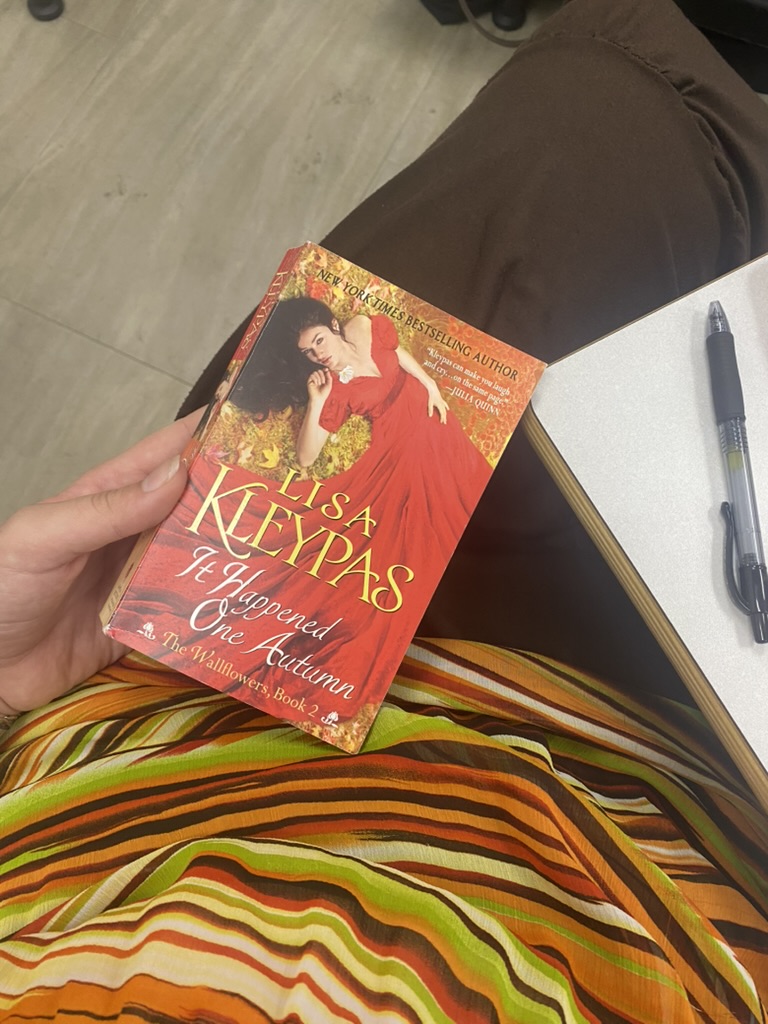
I found a book today in a Little Free Library that matched my outfit. It Happened One Autumn, Lisa Kleypas’ second book in her Wallflowers regency romance series. I’m in yellows, oranges, browns; the fall colors. The book is bright red, orange, yellow; its title is autumnal.
—————————–
It’s fall in New Orleans. Fall here is different, not quite marked by distinct changes in the weather or trees, but more so by months that go by. August: summer; September: fall. But autumn in New Orleans does make itself known—the sun warms you without beating down, time moves a bit faster, partly because work and school demand it to do so, but also because the air’s less heavy, less sticky. However, when time moves fast, it also moves slow; it’s both whirlwind and slog.
That’s how I was feeling today. The morning whirled around me, but I was practicing slowness. I walked at a clip, late, as always, to a meeting. But in my hands, eclipsing my world, was Raechel Anne Jolie’s Rust Belt Femme. I was trying to cram in my reading for class during the only time that I had, my fifteen minute walk to campus. The sun was sweetly hot on my cheek and my body felt overwarmed from a lack of sleep. An old professor of mine used to tell me that el tiempo no se extiende como el chicle, time doesn’t stretch like a piece of gum, but it does. My walk was testament to that—it felt like a world unto itself, a little moment that slipped between the rush of the morning and an-other space. Time stuck to me, on the bottom of my shoe, and I stretched it out, out, out as I walked. Rust Belt Femme was sweeping me away, stealing my time away and stretching in a fugitively powerful, cheekily rebellious way.
—————————–
When I reached for the book in the Little Free Library, the world felt burst open, the time-gum stretched too far and snapped. I was flung back to being thirteen-fourteen and discovering historical romance, the perfectly small paperbacks that fit neatly into a coat pocket and the palm of my hand; the emotionality that popped on my tongue; the familiar story weavings and threadings that each novel carried. Lisa Kleypas’ Wallflowers series was one of my earliest loves. In fact, Devil in Winter, the book that comes directly after It Happened One Autumn, is the book I have read the most times in my life (there was a time in my life when, every day, I would come home from school and read that book in its entirety). Being flung back in time also made me viscerally aware of the present (time is weird like that—we think of it as one straight line, but really, truly, it’s just a nebulous cloud of moments, pinging off each other). That’s why the first thing I noticed was both that it was an old love and that it matched my (current) clothes.
I nestled the book in the crook of my arm and walked jauntily to class. The air felt lighter, somehow, with that book in my hand. Which is weird, because those books are, for lack of a better word, supremely fucked up. I know that now, having done analysis and learning about race and class and gender and how these books definitely present a hegemonic white femininity and very toxic white masculinity, but they do, still, feel like home in a big way. And that’s weird, and I’m never really sure what to do with it, but it’s also true.
In class, with one of my favorite professors, we unpacked time. It felt all too fitting. He asked us: what does it mean to be skeptical of time itself? We talked about Rahsaan Mahadeo’s Funk the Clock, specifically his chapter entitled “Why is the Time Always Right for White and Wrong for Us?” where he explains that it may be more generative to ask “Whose time is it?” rather than “What time is it?” Mahadeo’s writing is beautiful and intimate and makes you think outside of the (white) clock-bound time that limits our imagination, our bodies, and our liberation. My professor, thinking along with Mahadeo, and whose words always enrapture me, says that time is a type of positioning, a social phenomenon. He says, if you’re at a party, and the clock strikes midnight, you don’t feel like it’s the next day—even though the clock dictates otherwise. Mahadeo writes that whiteness “functions as a cognitive frame orienting people to both time and space.” In other words, Time, the one we think about as neutral, unchanging, static, is as constructed and affected by race as any other aspect of our social world. Whiteness creates a boxed-in, linear, progressive time, one that historical romance novels, however limited and messy they may be, break through. They burst open time as a static object, playing with history and the past as if they are both fantastical and present, current. Non-white and/or queer historical romance authors especially engage this divergence from normative conceptions of time, since they write from a positioning with(in/out) Western Standard Time (as time theorist La Marr Jurelle Bruce terms it) that is already marked as “other” or “external.” By returning to the past, re-engaging it and re-membering it, these authors rethink how to conceptualize time and resist a singular understanding of time, history, and the past.
In the class immediately after, we thought collectively about autotheory, which Arianne Zwartjes defines as “the chimera of research and imagination” and “ways of mixing ‘high theory’ with our panting, sweating physicality, the embodied experience.” Examples of published, official autotheory are works like Jolie’s Rust Belt Femme and Christina Sharpe’s In the Wake. But I would argue that people are constantly enacting autotheoretical work: in classrooms, on the street, in music, around the dinner table—just talking about our lives and theorizing from them. Using lived experience as the starting point for theory and research is a vital and generative practice, which is why my personal experience reading romance guides a lot of my research into the genre.
Historical romance has always bent time for me; as literature often does, reading historical romance creates a liminal pocket of spacetime, in which time feels concurrently endless and rapid. Hours would pass through my fingers in a matter of moments, as I immersed myself in worlds that felt both familiar and far away. Even as time passed rapidly, though, the space that I occupied while holding a historical romance novel in my hands felt like a bubble outside of time, like the time around me froze while I read. Although a lot of books have the power to manipulate time, there’s something specific and unique about romance, particularly historical romance, for me. I think a big part of it comes from the fact that historical romance novels engage time so explicitly.
Finally, Janice Radway, an epochal early scholar of romance literature, found in her 1984 book, Reading the Romance, that reading romance was a form of stealing away time for white, suburban women. It gave them the space and time to leisure, to care for themselves and be allegorically cared for through the male love interest in the book, and to escape from the gendered pressures of Western Standard Time. Although Radway’s work is limited by its pervasive whiteness, this idea of romance reading as a way of stealing away time is an important one. That very pocket of spacetime that historical romance novels create, that liminal space of rapidity and endlessness, is a subversive location both within and without the dominant temporal systems.
And so, I keep It Happened One Autumn on my desk, watching as it gets bathed in the morning sun, and I let myself stand happily on the uncertain waves of time, which pulse and crash and stretch and thin, all at the same time. Time twists around my finger and twirls my hair, and I move with it—striving, always, for the temporal feeling that historical romance creates.
Works Cited
Bruce, La Marr Jurelle. “Interludes in Madtime: Black Music, Madness, and Metaphysical
Syncopation.” Social Text, vol. 35, no. 4, 2017, pp. 1–31,
https://doi.org/10.1215/01642472-4223369.
Kleypas, Lisa. It Happened One Autumn. Avon, 2005.
Mahadeo, Rahsaan. Funk the Clock: Transgressing Time While Young, Perceptive, and Black.
1st ed., Cornell University Press, 2024, https://doi.org/10.1515/9781501774225.
Radway, Janice A. Reading the Romance: Women, Patriarchy, and Popular Literature. 1st ed,
University of North Carolina Press, 1984.
Zwartjes, Arianne. “Autotheory as Rebellion: On Research, Embodiment, and Imagination in Creative Nonfiction.” Michigan Quarterly Review, sites.lsa.umich.edu/mqr/2019/07/autotheory-as-rebellion-on-research-embodiment-and-imagination-in-creative-nonfiction/.

 Love in the Time of the Feminist Subjunctive
Leave a reply to verypleasantly913d284c32 Cancel reply